
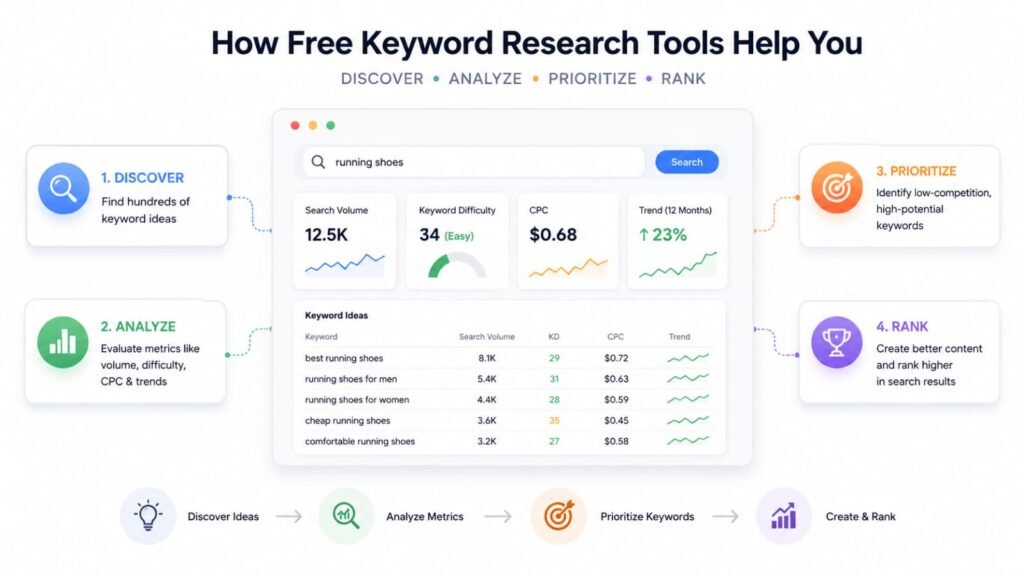
Best Free Keyword Research Tools any time doing Search Engine Optimization you already know what people promise: just use free keyword research tools and you will rank high on search engines. The truth is that free tools give you just enough information to think you know what you are doing. And just enough wrong information to make a bad decision.
After working with different Free Keyword Research Tools on many projects one thing becomes clear very quickly: not all free tools are the same and the differences between them are more important than most Search Engine Optimization blogs say. This post will look at the popular free keyword research tools, what the information, from these tools really looks like when you use them and where each keyword research tool has problems.
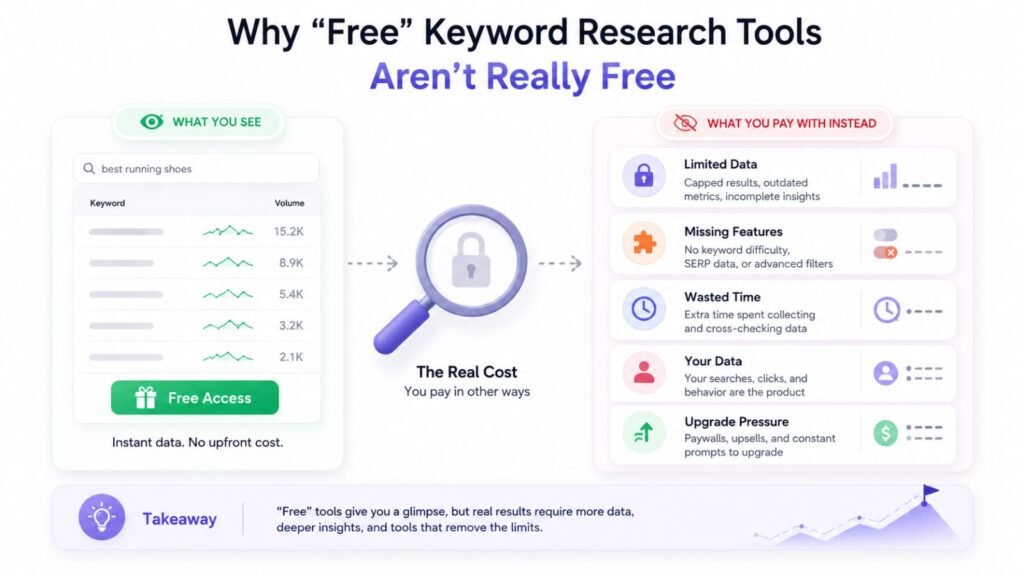
When we talk about things that’re free we need to think about what we are really getting. The thing that it costs is not money it is how precise the results are. When we use tools they often do not give us all the information we need. They might not show us the range of things or they might limit the results. Sometimes they even try to get us to pay for an upgrade.
The people who are good at researching keywords know what they can work with and what they should not waste their time on. Keyword research is, like that we have to know which things we can work around and which things are not worth it. We do not want to spend hours doing something that will not help us with our keyword research.
Google Keyword Planner: The Industry Baseline
Best for: Advertisers, beginners, and validating keyword intent
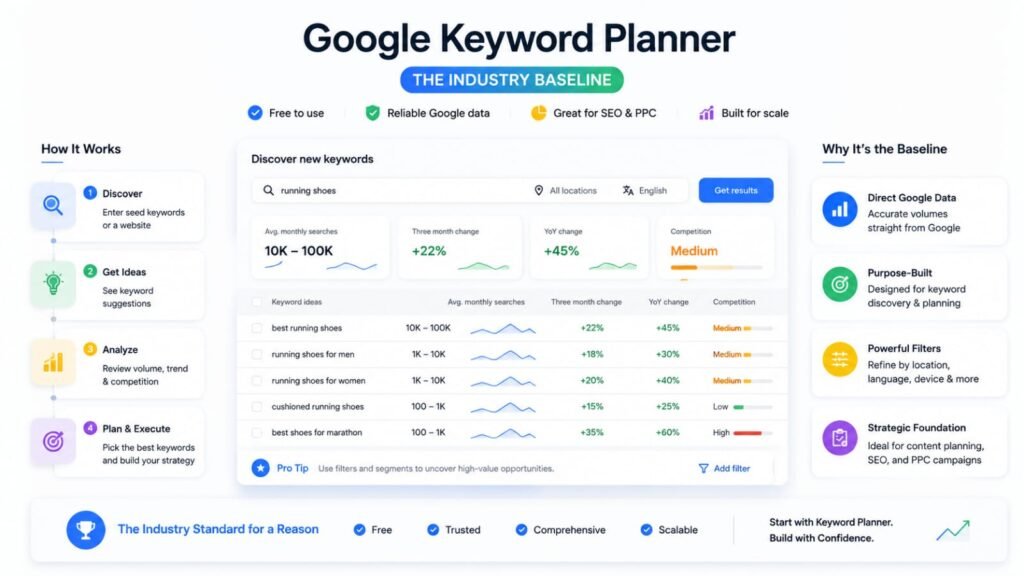
Google Keyword Planner is the most widely used free keyword tool in the world — and for good reason. It pulls data directly from Google’s own ad platform, which means the traffic potential it shows is tied to real search behavior, not estimated panel data.
- Source reliability: Because the data comes straight from Google, you’re working with the most authoritative search volume signal available for free.
- Keyword discovery: The “Discover new keywords” feature is genuinely useful for finding related terms and grouping them by theme.
- Intent signals: Ad competition levels give you a rough proxy for commercial intent — high CPC usually means buyers are searching, not just browsers.
The Real Limitations
Here’s what most reviews gloss over: Keyword Planner rounds and buckets search volumes aggressively unless you’re running an active Google Ads campaign. Without spend, you’ll often see ranges like “1K–10K” instead of exact numbers. That’s a massive gap that makes prioritization difficult.
Other frustrations practitioners run into:
- Long-tail terms get lumped together — related phrases are often grouped, making it hard to assess individual keyword potential.
- It’s built for ads, not organic SEO — the tool optimizes for bidding decisions, not content strategy. Competition scores reflect paid competition, which doesn’t always map to organic difficulty.
- No SERP data — you can’t see who’s ranking or how hard it would be to break into the top 10.
Verdict: Google Keyword Planner is a solid starting point, especially for validating that a keyword has real search demand. But using it as your only tool means making content decisions with blurry data.
Google Search Console: The Underrated Free Keyword Research Tools Most People Ignore
Best for: Improving existing pages
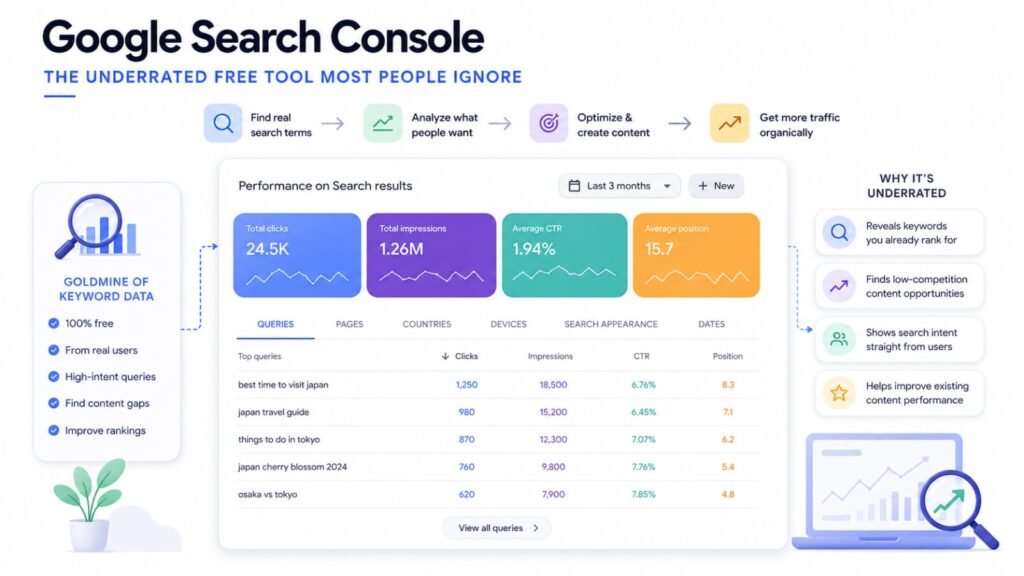
If you are not using Google Search Console (GSC) for finding keywords you are missing out on information. Unlike Keyword Planner GSC shows you keywords that your site is already ranking for including ones you did not plan for.
The “Performance” report shows you how times your site appeared in search results how many clicks you got and where your site appeared on average for every search term that brought people to your site. This is how you find wins: keywords that are in positions 8 to 15 and just need a good content update to get more traffic
Limitation: GSC only shows data for your website and only keeps data for 16 months. It won’t help you come up with ideas, from scratch.
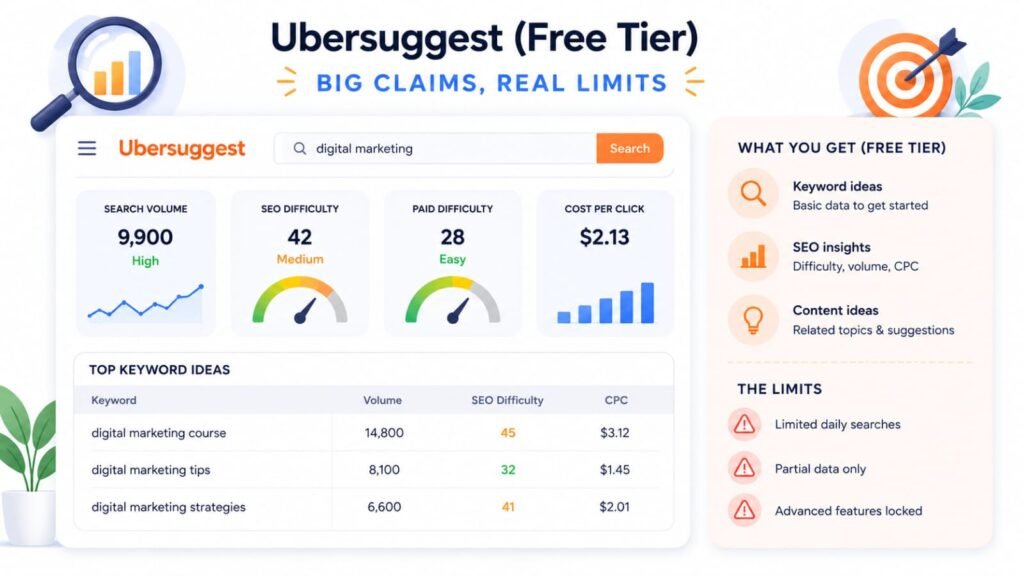
Ubersuggest (Free Tier): Big Claims, Real Limits
Best for getting keyword ideas without paying for a tool.
Ubersuggest has a version that gives you keyword ideas, rough ideas of how many people are searching for something and basic ideas of how hard it is to get a good spot on search engines. This seems great for people who are just starting out.
For people who have used tools like Ahrefs or Semrush they might notice that Ubersuggest is not always right.
The numbers that Ubersuggest gives you can be wrong. Sometimes they are too high. Sometimes they are too low. This depends on what you’re looking for. The score that shows how hard it is to get a spot on search engines is often too low which can make people think it is easier than it really is.
Verdict: Ubersuggest is good, for thinking of ideas but you should not make decisions based on what Ubersuggest says without checking it with another tool.
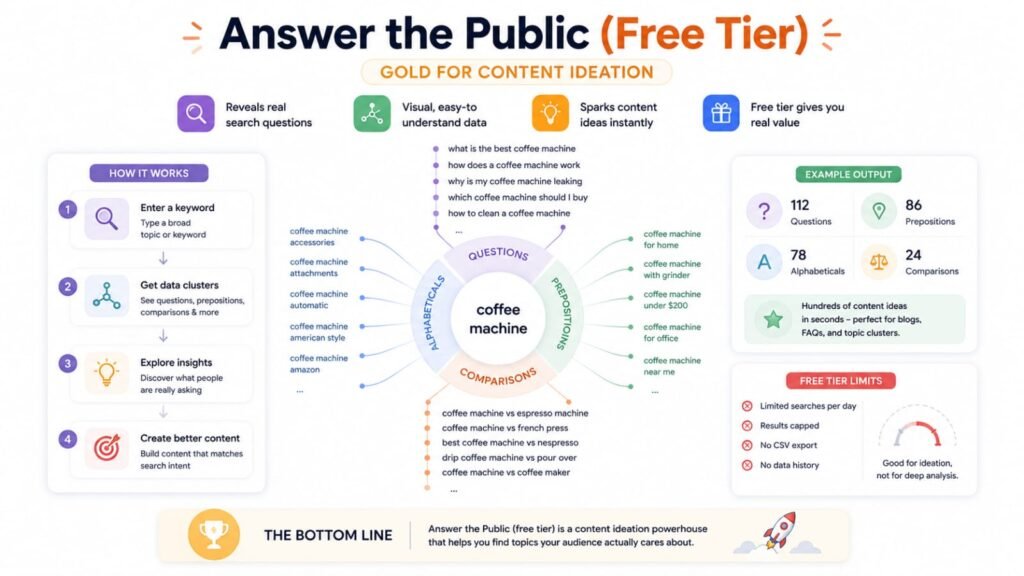
AnswerThePublic (Free Tier): Gold for Content Ideation
Best for: Finding question-based and long-tail keyword angles
AnswerThePublic visualizes the questions, prepositions, and comparisons people search around a core topic. It’s one of the best free tools for content ideation — particularly for blog posts, FAQs, and YouTube content.
What it doesn’t give you is volume data. You’ll see what people are asking, but not how many people are asking it. Pair it with Keyword Planner or GSC to validate demand before building content around a topic.
Best Free Keyword Research Tools Stack That Actually Works
Rather than relying on a single free tool, experienced SEOs layer them:
Accuracy: What Free Tools Get Right (and Wrong)
To get started with a Free Keyword Research Tools workflow you use AnswerThePublic. AnswerThePublic is great for finding question-based angles and content gaps. It helps you come up with content ideas.
Next you need to see if these ideas are good. You do this with Google Keyword Planner. Google Keyword Planner gives you some idea of how many people’re searching for something. It also suggests keywords that you can use.
Then you should check Google Search Console. Google Search Console shows you if people are already looking at your site when they search for things. This is really useful because it shows you how your site is actually doing.
After that you need to see who else is trying to rank for the keyword. You do this by searching for the keyword in Google and looking at the results. You have to be honest with yourself about how hard it will be to beat them.
You can also use Ubersuggest Free to get ideas. Ubersuggest Free is good for thinking of things to write about.. It is not so great, at telling you how many people are searching for something or how hard it is to rank for a keyword.
AnswerThePublic and Google Keyword Planner and Google Search Console and Ubersuggest Free are all tools. They can help you get started.. They will not do everything a Free Keyword Research Tools can do. Still they can help you a lot. They can get you further than you might think.
FAQs
Is Google Keyword Planner accurate for SEO? It’s the most reliable free source for search volume directionally, but the bucketed ranges (without an active Ads account) make precise prioritization difficult. Use it to confirm demand, not to rank keywords against each other by exact volume.
What’s the most accurate Free Keyword Research Tools ? For your own site, Google Search Console is the most accurate because it pulls real data from Google. For discovering new keywords, Keyword Planner is the most trustworthy — though still imperfect.
Can you do keyword research with only Free Keyword Research Tools ? Yes — especially when you’re starting out or working with a limited budget. The key is stacking tools to compensate for each one’s blind spots, and being honest about the limits of your data when making decisions.
When should you upgrade to a Free Keyword Research Tools ? When you’re producing content regularly, competing in a crowded niche, or need reliable difficulty scores to prioritize content investment, a paid tool pays for itself quickly. Ahrefs and Semrush are the industry standards.
Final Thoughts
Free keyword research tools are not a shortcut — they’re a starting point. Google Keyword Planner remains the most useful free option for most people because the data comes directly from Google, even if the interface is built for advertisers. The real skill is knowing what each tool can and can’t tell you, and building a research process that accounts for the gaps.
The SEOs who get the most out of free tools aren’t the ones who trust a single platform — they’re the ones who triangulate across multiple sources and make decisions with appropriate uncertainty built in.
Start there, and you’ll already be ahead of most people publishing content based on a single search volume number they read from a free dashboard.